China Launches WAICO: A Rival AI Governance Body That Splits the World
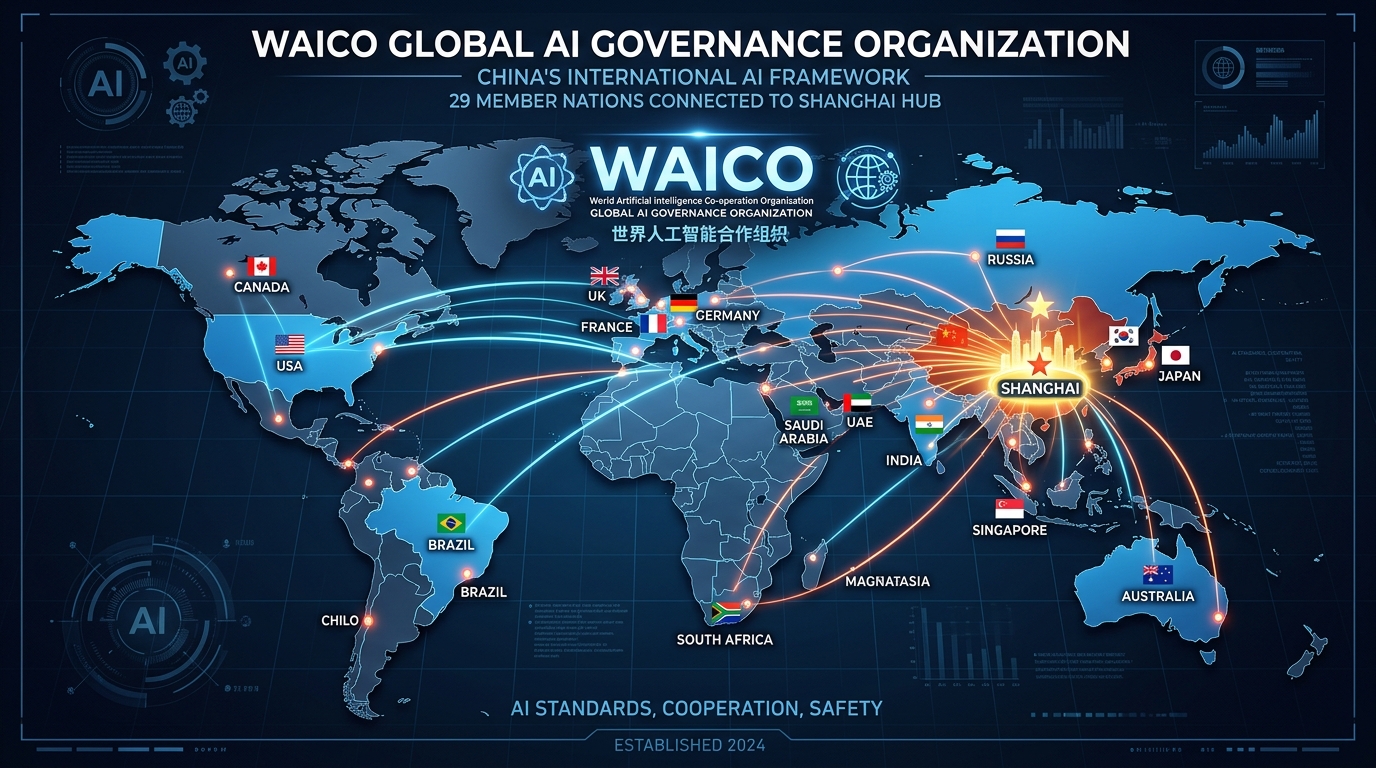
On July 16, 2026, on the eve of the annual World Artificial Intelligence Conference (WAIC) in Shanghai, Chinese President Xi Jinping announced the formal establishment of the World Artificial Intelligence Cooperation Organization (WAICO). Twenty-nine countries signed the founding agreement, and the organization is now headquartered in Shanghai. Its mission: to build an alternative governance framework for AI that explicitly centers developing nations — and deliberately sidelines the United States and the European Union.
This is not a minor policy announcement. WAICO is a direct geopolitical move that formalizes the AI world's split into two distinct camps, each operating under a different set of rules, standards, and values. If you work in tech, invest in AI, or simply care about who decides the future of this technology, this development demands your attention.
What Is WAICO and Why Did China Create It?
What is WAICO and how does it differ from Western AI governance bodies? WAICO (World Artificial Intelligence Cooperation Organization) is an intergovernmental body founded by China on July 16, 2026 in Shanghai. Unlike the G7 AI governance frameworks or the OECD AI Principles, WAICO is explicitly development-oriented, focusing on capacity-building for the Global South, joint technical standards, and a "people-centered" AI philosophy promoted by Beijing.
The founding members are largely drawn from the Global South and aligned blocs: Russia, Brazil, Kazakhstan, Pakistan, Indonesia, Laos, and over 20 other countries from Africa, Asia, and Latin America. Notably absent are the United States, the European Union, Japan, and South Korea — all of which have their own established AI governance coalitions.
China's motivation is transparent and strategically sound. For years, Beijing has complained that Western AI standards — particularly those emerging from the EU AI Act, the OECD, and US export controls — are designed primarily to contain Chinese technological advancement while legitimizing Western market dominance. WAICO is China's counter-offer to the developing world: join us, we'll build your AI capacity, and we'll shape the global standards together.
The 29 Founding Nations: A New Geopolitical Bloc
The choice of founding members reveals WAICO's underlying logic. The organization is essentially an extension of China's existing diplomatic architecture — BRICS, the Shanghai Cooperation Organization (SCO), and the Belt and Road Initiative (BRI) — now applied to the AI domain.
Russia's inclusion is symbolically significant: two major authoritarian tech powers jointly establishing an AI governance body is a clear signal to Washington. Brazil's participation suggests that even countries with complex Western relationships see value in China's alternative framework. Pakistan and Indonesia, both large and strategically important nations, add significant population weight to the bloc.
By targeting developing nations, China is betting on the future. The Global South represents the majority of the world's population and increasingly significant AI markets. If WAICO successfully sets technical standards, data-sharing protocols, and AI development frameworks for these countries, Chinese AI companies will have a structural advantage over US competitors in those markets for decades to come.
US, EU, Japan, and South Korea: Why They Refused
The non-members are as telling as the members. The United States has not joined WAICO, and the White House has reportedly characterized it as an attempt to legitimize China's model of state-directed AI development — one that prioritizes national sovereignty over individual privacy, and efficiency over transparency.
Japan and South Korea, both currently engaged in ambitious national AI strategies, similarly declined. Japan's Noetra consortium is explicitly building "sovereign" AI independent of both US and Chinese ecosystems. South Korea's Basic AI Act is focused on domestic security and semiconductor supremacy. Neither country wants to be absorbed into a Chinese-led governance standard.
The European Union, whose AI Act is the world's most comprehensive existing regulatory framework, sees WAICO as incompatible with its risk-based, human-rights-centered approach. Brussels will continue pushing its own standards through bilateral agreements and multilateral forums like the UN's AI Advisory Body.
What WAICO Actually Does: Standards, Capacity-Building, and Data
On a practical level, WAICO has three core mandates announced at its founding:
1. Technical Standards Development: The organization will work to establish AI standards for model transparency, safety testing, and deployment protocols. These standards will be promoted within member countries and submitted to international bodies like the ITU. If adopted widely, they would present an alternative to the IEEE, ISO, and NIST standards that currently dominate global AI governance.
2. Capacity-Building Programs: WAICO will provide AI training, infrastructure grants, and model-access programs to developing member countries. This is a direct play for loyalty: countries that receive Chinese AI infrastructure will be far more likely to deploy Chinese models and adopt Chinese standards.
3. Data Governance Frameworks: Perhaps most strategically, WAICO will work to establish cross-border data-sharing agreements among member states. In a world where AI model performance is increasingly limited by data access, building a large pool of shared data across 29 nations creates a significant structural advantage for Chinese AI developers operating within the framework.
The Trump-Xi AI Summit: A September Reckoning
In a significant diplomatic development, the US and China have reportedly agreed in principle to hold a high-level AI summit between President Donald Trump and President Xi Jinping in Washington, tentatively scheduled for September 24, 2026. The agenda is expected to cover military AI, cybersecurity, and labor market disruption.
The timing is notable. WAICO's establishment in July almost certainly accelerated US willingness to engage. Washington is now watching a rival governance framework rapidly gaining membership — and the Trump administration, despite its generally confrontational posture toward Beijing, appears to recognize that unilateral isolation from this conversation carries its own risks.
Whether the September summit produces any binding agreements is uncertain. But its very scheduling confirms that the AI governance competition has now reached the highest levels of state diplomacy.
Conclusion
WAICO's establishment marks a watershed moment in global AI governance. The world now has two competing frameworks: the Western model emphasizing human rights, risk management, and transparency, and the WAICO model emphasizing development-oriented cooperation, national sovereignty, and what Beijing calls "AI for all." Neither framework is purely altruistic — both reflect the commercial and strategic interests of their founding powers. The question is which framework will shape AI deployment for the world's three billion internet users who don't live in the US or EU. The answer will determine which AI companies dominate the global market in 2030.
Frequently Asked Questions (FAQ)
What countries are founding members of WAICO? The 29 founding members include Russia, Brazil, Kazakhstan, Pakistan, Indonesia, Laos, and various nations from Africa, Asia, and Latin America. The US, EU member states, Japan, and South Korea did not join.
Is WAICO a threat to Western AI governance frameworks? It presents a direct competitive challenge rather than a military threat. By establishing alternative standards and providing AI capacity-building to developing nations, WAICO positions Chinese AI systems as the default choice for a large portion of the global market.
What is the difference between WAICO and the OECD AI Principles? The OECD AI Principles are non-binding guidelines emphasizing trustworthy, human-rights-respecting AI. WAICO is an intergovernmental organization with formal membership, binding technical standards work, and explicit capacity-building programs — making it operationally more active, at least in theory.
Follow AI Profit Hub for exclusive analysis of the global AI governance race — we cover every development that matters for the future of technology and business.
WAICO is being covered as a governance story, but it is fundamentally a market-capture strategy dressed in the language of multilateralism. China is not building WAICO because it cares about AI safety for developing nations — it is building it because it needs to lock in a market for its AI companies before US export restrictions, NVIDIA's chip dominance, and the EU AI Act effectively freeze Chinese models out of the global mainstream. The 29 founding nations aren't just geopolitical allies; they are future customers for Huawei servers, Alibaba Cloud services, and Qwen API subscriptions. The West's response — dismissing WAICO as a propaganda exercise — is strategically naive. When China builds the AI infrastructure for Indonesia, Kazakhstan, and Brazil, it isn't just winning a governance argument. It's winning the market. The US and EU need a serious counter-offer for the Global South, and they don't have one yet.