Clash of the Titans 2026: Does xAI's Grok 3 Beat OpenAI's GPT-5.6?
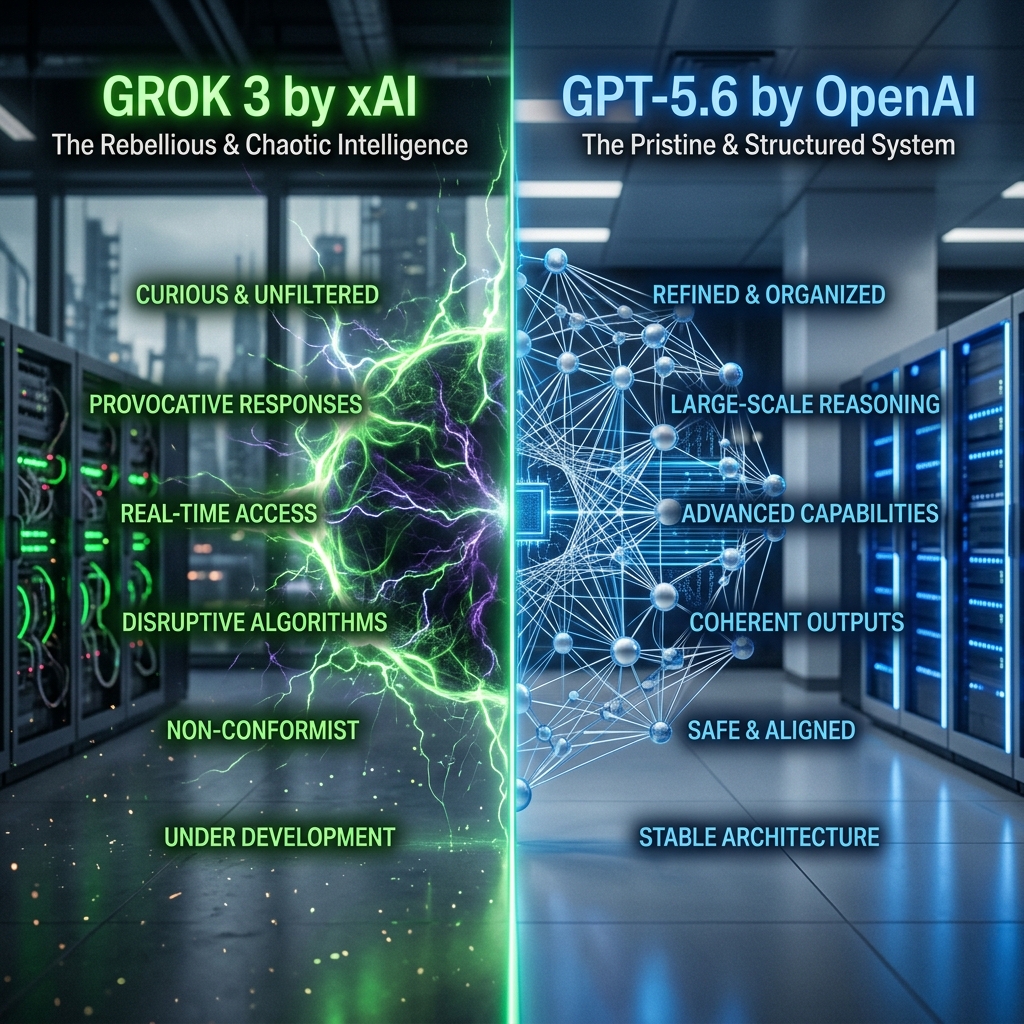
In mid-2026, the artificial intelligence landscape has reached an unprecedented boiling point. The battle is no longer about "who can write a better poem," but about "who has the most powerful model for scientific research, solving complex mathematical equations, and real-time open access to live information." At the heart of this conflict stand two giants: OpenAI with its latest and most powerful model, GPT-5.6, and xAI, led by Elon Musk, with its disruptive model Grok 3, powered by the world's largest supercomputer.
In this article, we will put both models under the microscope in a comprehensive and deep comparison. We will review their technical capabilities, the computing architecture behind them, which one offers true reasoning, and who will shape the future of generative AI.
What is the main difference between Grok 3 and GPT-5.6? The fundamental difference lies in their **philosophy and training data**: **GPT-5.6** from OpenAI focuses on "Deep Tiered Reasoning," where the model takes its time to think through complex tasks and provide carefully considered, entirely safe answers thanks to rigorous RLHF (Reinforcement Learning from Human Feedback). In contrast, **Grok 3** from xAI focuses on "instant open access to information" through its deep integration with the X platform (formerly Twitter). It prides itself on being "rebellious" and lacking strict "woke" constraints, backed by unmatched raw computing power from the massive "Colossus" supercomputer in Memphis.
1. The Compute Race: The Battle of the GPUs
AI in 2026 is essentially a numbers and compute game. Whoever owns the silicon rules the world.
The Colossus Supercomputer (Behind Grok 3) xAI has assembled the most powerful compute cluster recorded in human history to date, known as "Colossus." This massive machine features over 100,000 Nvidia H100 GPUs, and by mid-2026, it was upgraded with an additional 50,000 of the newer H200 and B200 units. This brute-force computing power allowed Grok 3 to finish its training period in record time and with a parameter size that makes it one of the largest models ever created. The sheer scale of Colossus means xAI can iterate faster than almost anyone else in the industry.
Microsoft and OpenAI Partnership (Behind GPT-5.6) OpenAI does not rely on a single centralized supercomputer; instead, it leverages Microsoft's distributed Azure cloud architecture, valued at tens of billions of dollars. What distinguishes OpenAI's architecture is its focus on "training efficiency" and a highly advanced Mixture of Experts (MoE) structure. This allows the model to activate only specific parts of the neural network for a given query, saving energy and significantly reducing latency while maintaining massive overall capacity.
2. Deep Reasoning vs. Data Streaming
Here we find the most significant difference in how each model processes complex prompts:
OpenAI's Approach: Think Before You Speak With the GPT-5.6 series (which evolved from the o1 and Q-Star projects), OpenAI has implemented the concept of "Thinking Time." When you ask GPT-5.6 a complex math or programming question, it doesn't immediately spit out an answer. Instead, it enters a hidden reasoning loop where it tests multiple hypotheses, corrects its own errors, and only then presents you with the final result. This approach makes it the **undisputed most powerful model** for solving complex academic, engineering, and programming problems.
xAI's Approach: The Live Pulse of the Internet Grok 3 does not spend as much time in slow reasoning loops. Instead, it relies on "Real-time Awareness." The model is piped directly into the X platform's data stream, making it the fastest tool in the world for breaking news, reading market trends, and analyzing public opinion in real-time. If you ask Grok 3 about an event that happened 5 minutes ago, it will give you an accurate analysis complete with links to live tweets. Its ability to instantly parse the zeitgeist is completely unmatched by OpenAI.
3. Censorship and Safety (Safety vs. Freedom)
This has long been the philosophical battleground between Elon Musk and Sam Altman.
* GPT-5.6 (Corporate Safety): This model has been meticulously designed to be suitable for major corporations, banks, and government agencies. It undergoes rigorous Red Teaming to prevent it from generating harmful content, taking sharp political stances, or showing obvious bias. This makes it incredibly safe and reliable, but it can sometimes feel "restricted" or "overly sensitive" to creative users trying to push boundaries. * Grok 3 (Bold Freedom of Speech): Grok 3 prides itself on being "unrestricted" and offers a "Fun Mode." The model is ready to discuss controversial topics freely, rarely refuses prompts, and possesses a sarcastic sense of humor that sets it apart from the robotic tone of other models. However, this freedom makes it less appealing to large enterprises that fear the PR disasters of dangerous hallucinations or controversial outputs.
4. Features and Performance in Daily Use
Let's compare the two models in everyday tasks for users and developers:
| Task | Winner | Reason | | :--- | :--- | :--- | | Complex Coding and Systems Engineering | GPT-5.6 | Thanks to its tiered reasoning capabilities and its ability to absorb entire code repositories and anticipate bugs before they happen. | | Breaking News and Market Analysis | Grok 3 | Exclusive and direct access to X data gives it an edge that OpenAI simply cannot match right now. | | Creative Writing and Brainstorming | Tie | GPT-5.6 provides better structuring for long-form essays, while Grok 3 provides more lively, less robotic text. | | Vision and Image Analysis | GPT-5.6 | The precision of OpenAI's vision engine excels in analyzing medical charts, UI designs, and complex images. | | API Pricing | Grok 3 | xAI offers highly aggressive and competitive pricing (significantly cheaper) to lure developers away from the OpenAI ecosystem. |
5. Who Takes the Crown?
Competition in 2026 is no longer defined by "the absolute best model," but rather "the best model for the task."
OpenAI has turned GPT-5.6 into a serious B2B Productivity Engine, integrating it deeply into the operating systems of its partners (like Apple and Microsoft). If you are building an application that relies on deep logical analysis and you cannot risk unpredictable answers, then GPT-5.6 is the gold standard.
On the other hand, Elon Musk has successfully placed Grok 3 in the pocket of every content creator, trader, and seeker of unfiltered information. The model's integration with X makes it a news agent that never sleeps, and the massive compute power behind it ensures it will never fall behind in catching up to the latest AI capabilities.
Conclusion
The release of Grok 3 in 2026 proves that xAI is no longer just a "side project" for Elon Musk; it is an apex competitor capable of disrupting the dominance of OpenAI and its GPT-5.6 model. While Sam Altman's model remains the king in complex reasoning tasks and enterprise (B2B) applications, Grok 3 has carved its name as the most powerful AI for live information and users seeking freedom (B2C). The next battle will be over who can provide truly Autonomous Agents that can perform tasks entirely on behalf of the user, something we are watching very closely.
Frequently Asked Questions (FAQ)
Can I use Grok 3 for free? Full access to Grok 3's capabilities is available exclusively to X Premium subscribers, whereas OpenAI provides free (though rate-limited) access to lighter versions of its models.
Is Grok 3 better at coding than GPT-5.6? Despite massive improvements, GPT-5.6 (and the o1 lineage) still excel in advanced programming tasks and complex engineering problem-solving due to their hidden reasoning loops.
Why is xAI's Colossus supercomputer special? It is the largest single-site cluster of AI chips in the world (over 150,000 Nvidia H100 and B200 chips), giving xAI the unparalleled ability to train massive new models in weeks rather than months.
For more in-depth analysis, check out How OpenAI Reshaped Tiered Reasoning Models in 2026.
HUSSEIN'S TAKE
The clash between Grok 3 and GPT-5.6 represents more than just technical rivalry; it is a clash of two very different mindsets. OpenAI represents the "Walled Garden" approach, where the model is a safe, reliable, and slightly boring office assistant. Elon Musk and the xAI team represent the "Brute Force" approach, prioritizing speed, raw power, and live data even if it gets a bit chaotic. As a developer, I find myself using GPT-5.6 to write code and build complex software architectures because it minimizes errors. But when I want to analyze a specific trend on social media or get an instant take on a breaking event, Grok 3 is my only tool of choice. The real winner here is the end-user who can combine the capabilities of both.