Qwen 3.8-Max vs. Claude Opus 5: The New Frontier of AI Efficiency (July 2026)
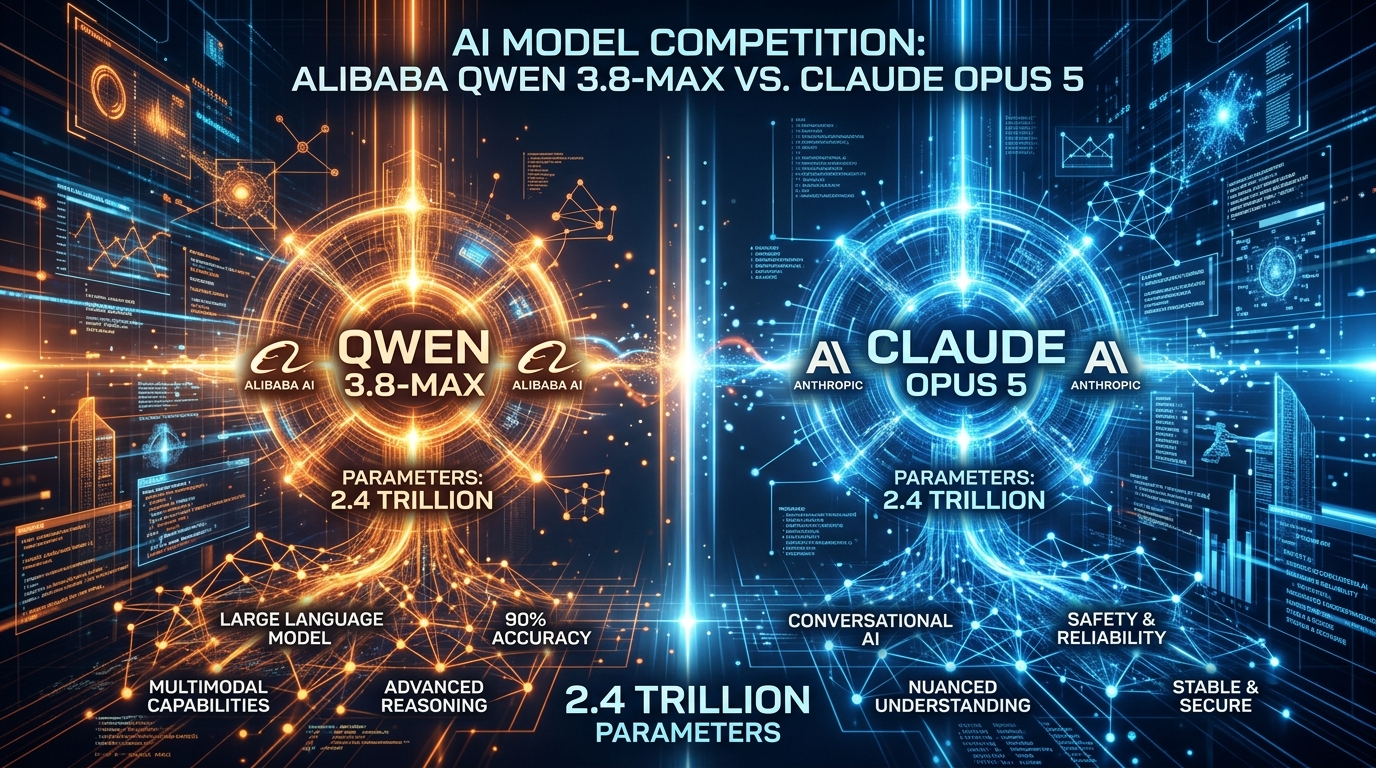
July 2026 delivered two major model launches from completely different corners of the world — within five days of each other. On July 19, Alibaba unveiled Qwen 3.8-Max at the World Artificial Intelligence Conference in Shanghai: a 2.4-trillion-parameter multimodal beast that the company claims is "second only to Claude Fable 5." Five days later, on July 24, Anthropic launched Claude Opus 5: a production-ready model delivering near-Fable-5 performance at half the flagship price.
These two models are not competing for the same users yet — Qwen 3.8-Max remains a preview with no open-weight release date confirmed, while Opus 5 is live in production across Claude.ai and GitHub Copilot. But they define the same question: what does the next tier of frontier AI look like when cost-efficiency becomes the primary battleground?
Qwen 3.8-Max vs Claude Opus 5: Key Comparison (60-Word Answer)
How do Qwen 3.8-Max and Claude Opus 5 compare? Both are frontier-class models with 1-million-token context windows targeting coding and complex enterprise tasks. Qwen 3.8-Max (2.4T parameters, MoE, multimodal) is Alibaba's largest model — currently preview-only with no pricing announced. Claude Opus 5 (fully launched, $5/$25 per million tokens) offers near-flagship performance with default extended thinking and GitHub Copilot integration.
Head-to-Head Specifications
| Feature | Qwen 3.8-Max | Claude Opus 5 | |---|---|---| | Developer | Alibaba (China) | Anthropic (USA) | | Launch Date | July 19, 2026 (preview) | July 24, 2026 (GA) | | Parameters | 2.4 trillion (sparse MoE) | Undisclosed | | Architecture | Mixture-of-Experts | Transformer (estimated) | | Context Window | 1M tokens | 1M tokens | | Modalities | Text, Image, Video, Documents | Text (primarily) | | Extended Thinking | Yes | Yes (default ON) | | API Availability | Preview (Token Plan / Qoder) | Full production | | Open Weight | Promised (no date) | No | | Pricing | TBD | $5 input / $25M output tokens | | GitHub Copilot | No | Yes |
Architecture and Scale: Why Parameters Don't Tell the Whole Story
Qwen 3.8-Max's 2.4 trillion parameters sound staggering. But the critical word is "sparse" — the model uses a Mixture-of-Experts (MoE) architecture, which means that only a fraction of those parameters are active on any given inference call. This is the same design philosophy behind Kimi K3's 2.8T parameter count and DeepSeek's earlier MoE breakthroughs: massive theoretical scale, efficient actual compute cost.
The practical implication is that Qwen 3.8-Max may run considerably faster and cheaper than its parameter count implies, particularly if Alibaba delivers on its promise to open-weight the model. MoE models on commodity hardware are the emerging frontier of cost-efficient AI deployment — and if Chinese developers can run Qwen 3.8-Max on Huawei Ascend clusters without NVIDIA dependency, the geopolitical implications are as significant as the technical ones.
Claude Opus 5's architecture is undisclosed, as is standard for Anthropic. Based on behavioral testing, it appears to use a more dense architecture optimized for reliability and consistency over raw parameter scale — which is why Anthropic can confidently promise production-grade uptime and API reliability in a way that a preview model cannot.
Performance Claims vs. Reality
Alibaba claims Qwen 3.8-Max is "second only to Claude Fable 5." This is based entirely on internal evaluations — no independent benchmarks, model cards, or third-party testing results have been published as of late July 2026. Early community testing through the Qoder preview platform has been enthusiastic, particularly for coding tasks where the model reportedly shows strong agentic capability. But "enthusiastic early community testing" and "verified benchmark performance" are not the same thing.
Claude Opus 5's positioning is more modest and more credible: Anthropic claims it approaches Fable 5 performance for coding and complex knowledge work. This claim is supported by API availability at scale, meaning independent developers can actually run systematic evaluations. Early SWE-bench and coding challenge results place Opus 5 solidly in the top tier of available models — above GPT-5.6 Sol for long-context coding tasks, according to several independent evaluations.
The honest comparison: Claude Opus 5 is a verified high performer available today. Qwen 3.8-Max is a potentially world-class model that may or may not live up to its headline claims when properly evaluated.
Pricing and Accessibility: Where the Gap Is Widest
This is where the comparison becomes most practically significant for developers and businesses:
Claude Opus 5: $5 per million input tokens, $25 per million output tokens. Available now on Claude API, Claude.ai, and GitHub Copilot. Enterprise pricing and volume discounts available. This is a known, plannable cost.
Qwen 3.8-Max: No pricing announced. Currently available as a preview through Alibaba's Token Plan and Qoder platforms under undisclosed terms. If Alibaba follows through on the open-weight release, self-hosted deployment could cost significantly less — particularly for organizations running on Alibaba Cloud or compatible infrastructure. But "significantly less eventually" is very different from "available now at a known price."
For businesses that need to build and deploy AI features on a budget and timeline today, Claude Opus 5 wins this comparison unambiguously. For organizations willing to wait and experiment, Qwen 3.8-Max's preview access is worth exploring — particularly for China-market applications where Alibaba's ecosystem integration may provide meaningful advantages.
Multimodal Capabilities: A Genuine Differentiator
Qwen 3.8-Max's multimodality is a genuine advantage that Claude Opus 5 does not currently match. The ability to process video, images, and complex documents natively — not just text — opens use cases in content moderation, medical imaging analysis, manufacturing quality control, and multimedia research that text-only models simply cannot address.
Anthropic's Claude models handle documents well and can process images when provided in certain formats, but native video understanding and the kind of complex layout analysis that Qwen 3.8-Max reportedly supports represents a different capability tier for visual tasks.
If your use case is primarily text-based — coding, writing, research, document analysis, customer service — multimodality provides no advantage and Claude Opus 5 is the more practical choice. If you need to analyze video footage, process complex visual layouts, or integrate across text and image modalities at scale, Qwen 3.8-Max's eventual release could be transformative.
Open-Weight Promise: The Wildcard
Alibaba has stated that an open-weight version of Qwen 3.8-Max is coming. No date, no license terms, no technical specifications for the release have been provided. But if and when it arrives, it could fundamentally alter the competitive landscape.
An open-weight 2.4-trillion-parameter MoE model would be the largest freely available model in history. Organizations could fine-tune it for their specific domains, deploy it on private infrastructure, and avoid per-token API costs entirely. This is the scenario that makes Anthropic most nervous — and it's why the Claude Opus 5 launch at competitive pricing is partly a preemptive move to lock in enterprise customers before Qwen's open-weight release materializes.
Conclusion
Both models represent the next generation of cost-efficient frontier AI, but they occupy different points on the availability-capability spectrum today. Claude Opus 5 is the smart choice for any organization that needs to build and deploy now — it's real, reliable, well-priced, and deeply integrated into the developer ecosystem. Qwen 3.8-Max is the model to watch for the second half of 2026: if Alibaba delivers on its multimodal capabilities and open-weight promise, it could become the most disruptive model release of the year. The best strategy for most organizations is to build on Opus 5 now while maintaining an active evaluation pipeline for Qwen 3.8-Max as more information becomes available.
Frequently Asked Questions (FAQ)
Is Qwen 3.8-Max better than Claude Opus 5? Based on available information, it is too early to make a definitive comparison. Qwen 3.8-Max's performance claims are based on internal evaluations only, while Claude Opus 5 has been independently tested and confirmed as a top-tier model. Qwen's multimodal capabilities and potential open-weight release could make it superior for specific use cases.
When will Qwen 3.8-Max be available as open weights? Alibaba has stated that an open-weight version is planned but has not provided a release date, license terms, or technical specifications as of late July 2026.
Which model is cheaper — Qwen 3.8-Max or Claude Opus 5? Claude Opus 5 is priced at $5 per million input tokens and $25 per million output tokens. Qwen 3.8-Max pricing has not been announced. If Alibaba releases open weights, self-hosted deployment could be significantly cheaper.
Read our in-depth analysis of China's WAICO AI governance launch to understand the geopolitical context behind Qwen's development. Follow AI Profit Hub for comprehensive AI model coverage updated as new benchmarks are published.
Stop treating Qwen 3.8-Max vs. Claude Opus 5 as a pure technical competition — it's a market strategy battle disguised as a model comparison. Anthropic released Opus 5 now, at full production availability and competitive pricing, because it knows Qwen 3.8-Max is coming. It's locking in enterprise contracts, Copilot integrations, and developer habits before Alibaba ships open weights. Alibaba's strategy, meanwhile, is to create maximum anticipation with the preview — then drop open weights in a way that makes paying for Claude feel unnecessary. The real question isn't which model is more powerful today; it's whether Anthropic can build sufficient switching costs into its ecosystem before Alibaba floods the market with a free alternative. If the open weights arrive by Q4 2026 and perform as promised, the economics of the enterprise AI market will change dramatically. Enterprises currently building on Claude Opus 5 should plan for that scenario now.