Sovereign AI Race: South Korea's Physical AI vs. Japan's Noetra Project
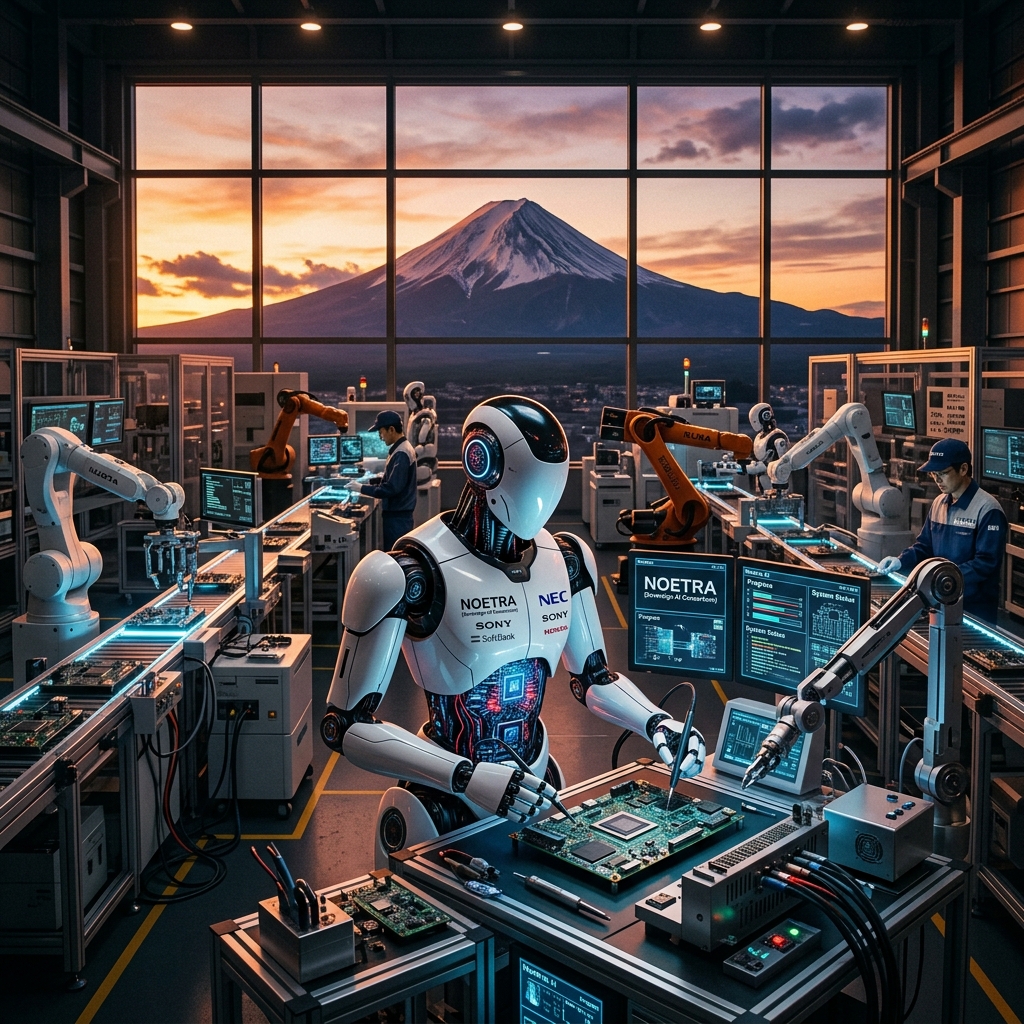
The global artificial intelligence arms race has definitively shifted away from a mere two-horse race between the United States and China. As we traverse through 2026, a new, equally critical theater of competition has emerged in East Asia, driven by the absolute necessity of "Sovereign AI." Two technological powerhouses, South Korea and Japan, have committed tens of billions of dollars to ensure they are not relegated to the status of AI client states dependent on Silicon Valley or Shenzhen.
However, what makes this geopolitical tech rivalry fascinating is that their strategic approaches are entirely divergent. South Korea is aggressively pursuing hardware and robotics dominance through "Physical AI," while Japan is focusing heavily on cultural and linguistic preservation through its massive software initiative, the "Noetra" Project.
What is Sovereign AI?
Sovereign AI refers to a nation's capability to produce artificial intelligence models using its own infrastructure, data, and talent. It guarantees that the AI system reflects the nation's cultural nuances, adheres to its specific legal frameworks, and operates independently of foreign political or economic leverage. For countries like Japan and South Korea, relying on OpenAI’s GPT or China’s DeepSeek poses existential risks to data security and cultural identity.
South Korea's Strategy: Dominating Physical AI
South Korea’s strategy leverages its historical dominance in memory chips (Samsung, SK Hynix) and heavy manufacturing. Rather than trying to beat OpenAI at creating the smartest chatbot, the Korean Ministry of Science and ICT has funneled its massive $7.5 billion AI budget for 2026 directly into Physical AI.
Physical AI focuses on embedding advanced artificial intelligence directly into robotic bodies, autonomous systems, and industrial machinery.
The Key Pillars of Korea's Approach:
1. AI Semiconductor Supremacy: South Korea is pushing beyond standard High Bandwidth Memory (HBM). SK Hynix recently unveiled its next-generation HBM4e, deeply integrated with logic chips to significantly reduce power consumption for edge AI devices and robots. 2. The "Embodied" Initiative: Major conglomerates like Hyundai and LG have shifted their R&D almost entirely toward Embodied AI. The goal is to deploy millions of humanoid and specialized robots in manufacturing, healthcare, and logistics by 2028. 3. Hyper-Scale Datacenters: Naver and Kakao are building massive, localized AI datacenters powered by sustainable energy to train specialized industrial models rather than general-purpose conversational agents.
South Korea correctly identified that the next major bottleneck in AI is not software, but the physical world. By controlling the brains of the robots and the memory chips that power them, Seoul aims to make itself indispensable.
Japan's Strategy: The Noetra Project and Cultural Preservation
Japan, conversely, has taken a fundamentally software and data-centric approach. Facing a severe demographic crisis and a rapidly aging workforce, Japan needs AI to sustain its economy. However, early reliance on Western LLMs revealed a critical flaw: these models fundamentally lacked an understanding of complex Japanese cultural contexts, honorifics (Keigo), and specific business etiquettes.
To combat this, the Japanese government, in collaboration with RIKEN and a consortium of tech giants including Fujitsu and NEC, launched the Noetra Project.
Core Elements of the Noetra Project:
1. Linguistic Purity: Noetra is a massive, multi-modal sovereign LLM trained exclusively on high-quality, fully licensed Japanese data. It avoids the "cultural dilution" seen in Western models that are primarily trained on English datasets. 2. Copyright Harmony: Unlike the US, where AI companies face relentless lawsuits from authors and publishers, Japan amended its copyright laws specifically to allow training on copyrighted materials under strict conditions, giving Noetra a massive, legally sound data advantage. 3. Fugaku-Next Integration: The model is being trained on "Fugaku-Next," Japan's next-generation supercomputer, ensuring that the entire supply chain from raw data to computed weights remains strictly within Japanese borders.
Japan’s primary goal is not to sell Noetra to the world, but to perfectly automate its own internal economy without surrendering its cultural sovereignty to foreign corporations.
Comparing the Two Strategies
| Feature | South Korea (Physical AI) | Japan (Noetra Project) | | :--- | :--- | :--- | | Primary Focus | Hardware, Robotics, Edge AI | Software, LLMs, Cultural Data | | Key Advantage | Semiconductor manufacturing | High-quality domestic data, lax training laws | | Primary Risk | High capital expenditure on hardware | Falling behind in multimodal reasoning capabilities | | Target Audience | Global industrial and robotics markets | Domestic businesses and automation |
Frequently Asked Questions
Why can't Japan and South Korea just use GPT-5.6? While they do use GPT-5.6 for general tasks, relying on it for critical infrastructure, government intelligence, and proprietary industrial design poses massive security and data sovereignty risks.
What is Physical AI? Physical AI (or Embodied AI) refers to artificial intelligence that interacts with the real world through hardware, such as humanoid robots, autonomous vehicles, and automated factory machinery.
Will Noetra be available globally? Currently, the Noetra Project is strictly aimed at the Japanese domestic market and is highly optimized for the Japanese language, making its global utility limited compared to multilingual models.
For more deep dives into the geopolitical landscape of artificial intelligence, stay connected with AI Profit Hub. Be sure to read our analysis on China's AI Model Distillation War for further context on the Asian AI market.
We are witnessing the fragmentation of the global AI ecosystem, and it is a necessary evolution. The "one model fits all" paradigm pushed by Silicon Valley is dead. South Korea and Japan prove that sovereign AI is not just about pride; it is about survival. South Korea’s bet on Physical AI is arguably the most lucrative long-term play in the world right now. While software models are quickly becoming commoditized and open-sourced (just look at Kimi K3), the physical hardware and robotic execution layer remain highly defensible moats. Japan’s Noetra is brilliant for preserving cultural integrity, but unless they can export its utility, it remains an expensive domestic luxury. Ultimately, the country that controls the physical embodiment of AI (South Korea) will have a much stronger geopolitical hand than the one that just controls the localized software.