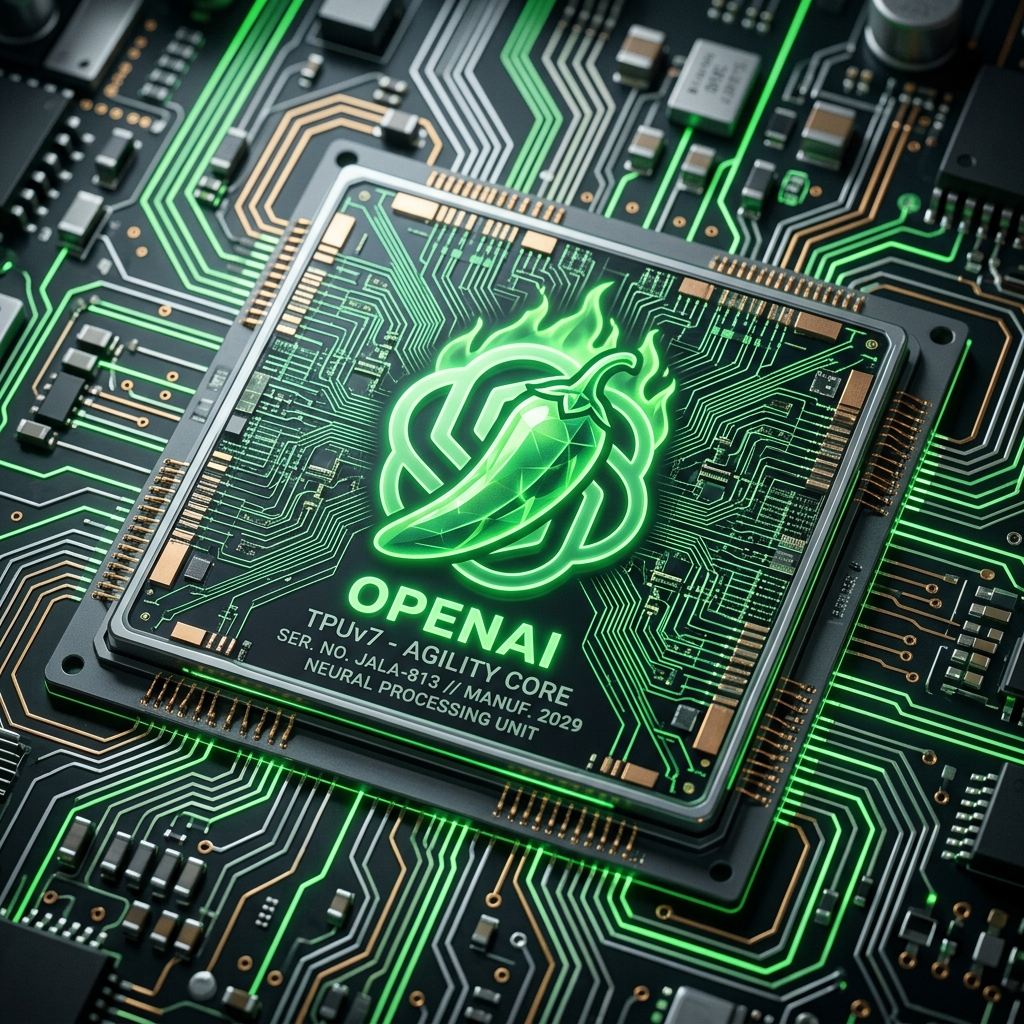
In the high-stakes chess match of artificial intelligence hardware, OpenAI has just made its most aggressive move yet. In a joint press release with semiconductor giant Broadcom, OpenAI officially unveiled **Jalape—o**, its first custom-designed silicon ASIC (Application-Specific Integrated Circuit). Built exclusively for large language model (LLM) inference, the chip is designed to tackle the skyrocketing computational costs of running frontier models like GPT-5 and ChatGPT in production, promising a staggering **50% reduction in inference costs per token**.
By bypassing Nvidia's high-margin graphic processors for daily inference operations, OpenAI is attempting to gain structural compute independence. While Nvidia GPUs remain the undisputed gold standard for *training* complex neural networks, the cost of running those networks for hundreds of millions of users daily is unsustainable using general-purpose GPUs. Jalape—o represents a shift toward specialized, hyper-optimized silicon designed for one job and one job only: running trained model weights at maximum speed and minimum power.
? Key Takeaways
- Why "Jalape—o"? Spicy Silicon for Spicy Models
- The Economics of Inference: The 50% Token Price Cut
- Nvidia's Monopoly Under Siege
- Future Rollout: When Will Developers Benefit?
Why "Jalape—o"? Spicy Silicon for Spicy Models
The codename **Jalape—o** reportedly originated from the chip's internal thermal management system. Built on TSMC's cutting-edge 3nm process node in partnership with Broadcom's custom ASIC design division, the chip is engineered to handle massive thermal densities. It utilizes an innovative on-die liquid cooling interface that allows the processor to run at maximum clock speeds for prolonged periods without thermal throttling.
Broadcom's role was pivotal in bringing Jalape—o to life. OpenAI provided the architectural requirements, specifying how the chip should route activation matrices and weight matrices for transformer-based architectures. Broadcom then integrated these specifications with their proprietary high-speed interconnect technology, allowing thousands of Jalape—o chips to communicate seamlessly within custom server racks with near-zero latency.
The Economics of Inference: The 50% Token Price Cut
The true genius of Jalape—o is not its raw processing power, but its cost-efficiency. General-purpose GPUs like Nvidia's H100 and B200 are designed to handle a wide range of mathematical operations—from graphics rendering to physics simulation and AI training. Consequently, a large portion of their silicon is dedicated to features that are useless for simple LLM text generation.
Jalape—o strips away all non-essential hardware. Its architecture is optimized specifically for matrix-vector multiplication, high-bandwidth memory (HBM3e) access, and dynamic quantization. By running models in specialized low-precision formats (such as FP4 and INT8), Jalape—o can execute inference cycles at a fraction of the electricity required by standard hardware.
According to early benchmarks provided by OpenAI, server nodes equipped with Jalape—o ASICs can process GPT-4o level models at double the throughput of standard nodes while drawing half the power. For developers, this translates to a massive drop in API costs, paving the way for cheap, agentic applications that can run in the background for hours without generating massive cloud bills.
Nvidia's Monopoly Under Siege
While Nvidia currently controls over 90% of the AI data center market, the launch of custom ASICs by its largest customers is a growing threat to its dominance. OpenAI joins a prestigious list of hyperscalers—including Google (TPU), Amazon (Trainium/Inferentia), Meta (MTIA), and Microsoft (Maia)—who are actively building their own silicon to bypass the "Nvidia Tax."
By moving inference workloads to their own custom chips, these companies can keep their margins high while slashing prices for end-users. Nvidia will likely remain the leader in bleeding-edge model training for the foreseeable future, but its highly profitable inference business is now facing intense competition from custom in-house ASICs.
Future Rollout: When Will Developers Benefit?
OpenAI has confirmed that the first production clusters of Jalape—o are already being installed in partner data centers, with Microsoft Azure serving as the primary hosting partner. The chips will initially power ChatGPT Plus queries and the API endpoints for developers using frontier reasoning models.
By the third quarter of 2026, OpenAI expects over 40% of its daily API traffic to run on Jalape—o silicon, which is projected to trigger a major price drop for enterprise API access. Developers can expect token costs to drop by up to 50%, making complex agentic loops and autonomous developer pipelines far more economically viable.
?? Editor's Opinion: Hussein Harby
"Jalape—o is the exact weapon OpenAI needs to survive the compute capacity crisis of 2026. General-purpose GPUs are simply too expensive and power-hungry to sustain the demands of agentic AI. Specialized ASICs built for inference are the future of the industry, and OpenAI’s partnership with Broadcom has successfully delivered a chip that will democratize low-cost AI agents."