Japan's $6.1B 'Noetra' Sovereign AI Consortium: SoftBank Leads National Robotics Revolution to Deploy 10 Million AI Robots by 2040
⚡ Key Takeaways
- Japan commits 1 trillion yen (~$6.1B) over five years to the 'Noetra' sovereign Physical AI initiative
- SoftBank leads a consortium including Sony Group, NEC, Honda, and national lab AIST
- First-phase funding of 387.3 billion yen disbursed in FY2026; METI allocates 14B yen to Toyota's Woven City for training data
- Goal: deploy 10 million AI-powered robots across 18 industries — from construction to elder care — by 2040
- Sony's 'Project Ace' robot defeats professional table tennis players; company phases out PlayStation disc production by January 2028
- Strategy explicitly designed to reduce Japan's dependence on US and Chinese large AI models
📋 Table of Contents
- What Is Project Noetra?
- The Consortium: Who Is Building Japan's AI Backbone?
- Physical AI: Japan's Strategic Bet on Embodied Intelligence
- Woven City and the Training Data Pipeline
- Sony's Parallel Revolution: Project Ace and the Post-Disc Era
- SoftBank's Global Play: SB Neo and the OpenAI Bridge
- The Geopolitical Stakes: Sovereignty Over Silicon
- Frequently Asked Questions
On the morning of July 1, 2026, Japan's Ministry of Economy, Trade and Industry (METI) released a 47-page policy document that will reshape the country's industrial landscape for the next two decades. The document formalized the creation of "Noetra" — a government-backed sovereign AI consortium tasked with building Japan's first domestically developed Physical AI foundation model. The price tag: 1 trillion yen (approximately $6.1 billion USD), disbursed over five fiscal years, with an immediate first-phase allocation of 387.3 billion yen for FY2026.
Unlike software-centric AI initiatives elsewhere, Noetra is built around a distinctly Japanese vision: intelligence that moves, builds, assembles, and cares. The initiative explicitly targets Physical AI — artificial intelligence systems embedded in robots, autonomous vehicles, factory automation arms, logistics drones, and elder care machines. In a nation grappling with a rapidly shrinking workforce, where nearly 30% of the population is over the age of 65, this is not a technology policy. It is a survival strategy.
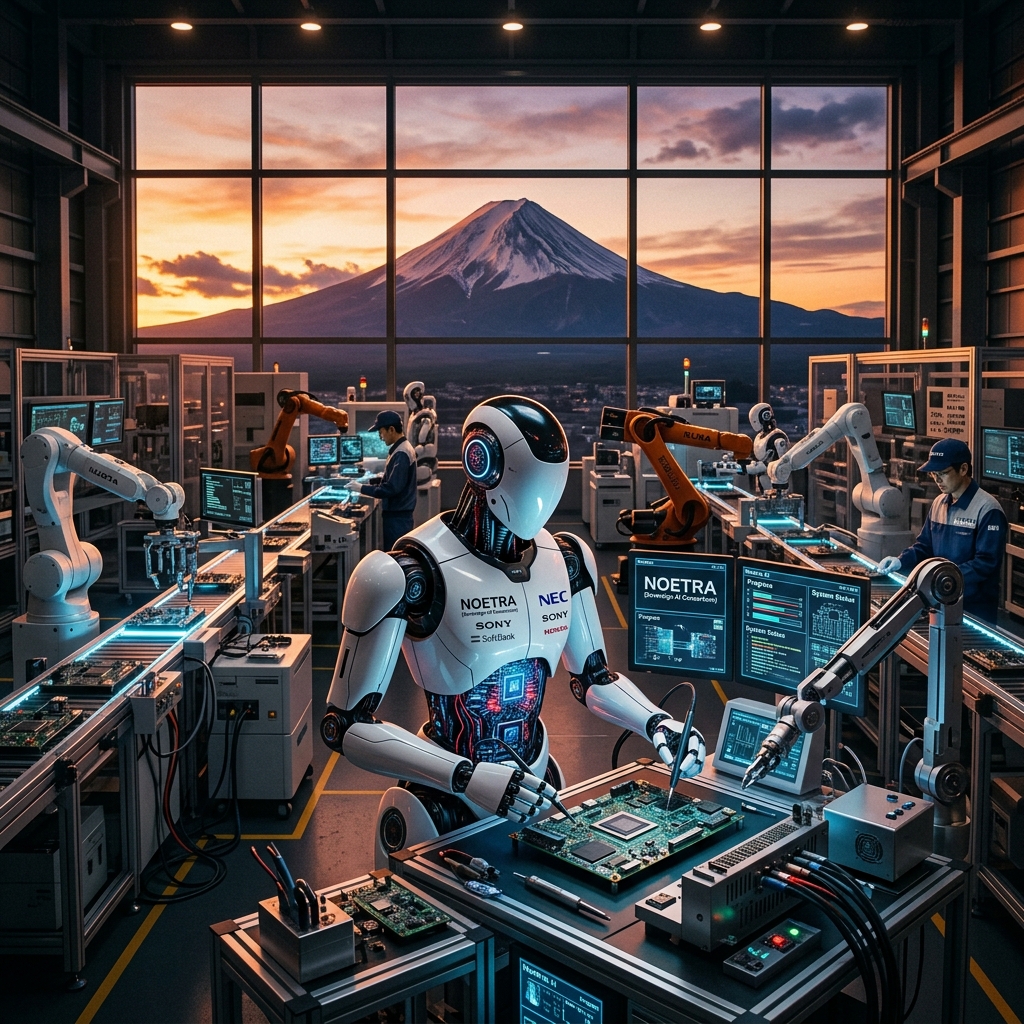
The consortium is led by SoftBank Corp — the domestic telecommunications arm of Masayoshi Son's empire — and brings together an extraordinary alliance: Sony Group, NEC, Honda Motor Co., and AIST (Japan's National Institute of Advanced Industrial Science and Technology). Together, these organizations cover the full stack from hardware and robotics to software, cloud infrastructure, and scientific research. The mission: build a sovereign AI system that can train 10 million AI-powered robots and deploy them across 18 critical industries by 2040.
What Is Project Noetra?
The name "Noetra" is derived from the Greek word noesis (intellect or understanding) and the Japanese suffix -tra, suggesting a transmission of understanding — a deliberate nod to Japan's ambition of becoming an exporter of AI-driven industrial wisdom. The project was first hinted at in METI's April 2026 AI White Paper, where it was described only as "Project Omega." The formal reveal on July 1 confirmed details that had circulated in Japanese business press for months.
At its technical core, Noetra is a foundation model training initiative. The consortium aims to develop a large-scale multimodal AI model specifically engineered for physical-world tasks — a Japanese-language-first, sensor-data-rich model that can process inputs from LIDAR arrays, robot joint encoders, factory floor cameras, haptic sensors, and real-time supply chain feeds simultaneously. This is architecturally distinct from general-purpose language models like GPT or Gemini, which are optimized primarily for text and image understanding.
The model's training infrastructure will be distributed across four national computing centers, anchored by NEC's newly commissioned Vector Engine clusters and supplemented by SoftBank's domestic cloud infrastructure. The total compute budget is estimated at over 50,000 petaFLOP-days of training — comparable in scale to GPT-4's original training run but optimized for physical-world simulation and robotic control data rather than internet text.
The Consortium: Who Is Building Japan's AI Backbone?
Each Noetra member brings a non-replicable capability that, combined, forms a vertically integrated AI stack unprecedented in Japanese industrial history.
SoftBank Corp — The Orchestrator
SoftBank Corp's role is that of systems integrator and primary funding conduit. Its nationwide 5G network — one of the most densely deployed in the world — provides the real-time low-latency connectivity backbone that edge-deployed robots will rely on for cloud inference. SoftBank's enterprise business division, which already manages AI-assisted call centers and smart building systems, will serve as the first commercial testing ground for Noetra's models. The company has committed to deploying at least 100,000 Noetra-powered service robots across its operational facilities by the end of FY2027 — creating a live feedback loop between production deployment and model improvement.
Sony Group — Sensors, Entertainment AI, and Project Ace
Sony's contribution spans three critical domains. First, its world-class image sensing division — responsible for roughly 50% of the global smartphone camera sensor market — will supply the high-resolution visual sensing arrays that form Noetra robots' primary perception layer. Second, Sony AI's research arm brings deep reinforcement learning expertise, most visibly demonstrated in its 'Project Ace' initiative, where a Sony AI agent recently defeated a ranked professional table tennis player in a full five-set match — a genuine milestone in embodied AI dexterity under real-world physical constraints. Third, Sony's content and entertainment data libraries provide a rich source of human behavioral data for training natural human-robot interaction models.
NEC — Compute Infrastructure and Biometric AI
NEC is Japan's premier enterprise computing and biometric AI company. For Noetra, NEC provides the Vector Engine HPC clusters that will anchor the consortium's central compute infrastructure, along with its advanced facial recognition and person-tracking systems that enable safe human-robot co-working environments. NEC's enterprise software relationships with Japan's major manufacturers also create natural commercial deployment channels for Noetra-trained models once they reach production readiness.
Honda — Autonomous Mobility and Robotics Heritage
Honda's participation brings decades of robotics research heritage — the company's ASIMO humanoid robot project, though discontinued, generated fundamental datasets about bipedal locomotion and human-environment interaction that are being contributed to the Noetra training corpus. More importantly, Honda's autonomous vehicle division will use Noetra's Physical AI models to accelerate its Level 4 autonomy roadmap in Japan's complex urban environments. Honda has committed to embedding Noetra's foundation model into 500,000 vehicles annually by 2029.
Physical AI: Japan's Strategic Bet on Embodied Intelligence
The decision to focus exclusively on Physical AI — rather than competing head-to-head with ChatGPT or Gemini in the general-purpose language model arena — reflects a sophisticated strategic calculus by Japan's policymakers. Japan has no realistic path to competing with the US or China in training the world's most powerful text-based LLMs: the compute costs are prohibitive and the English-language data advantage is insurmountable. But in Physical AI, Japan holds genuine structural advantages.
Japan's manufacturing sector generates more high-quality physical-world operational data per capita than any other nation — millions of hours of robotic arm trajectories, CNC machining sequences, precision assembly operations, and quality-control sensor readings accumulated over 40 years of factory automation leadership. This data, largely proprietary and locked within Japanese manufacturers, represents the training corpus that Noetra will systematically unlock through government-mandated data-sharing agreements with Toyota, Fanuc, Yaskawa, and Kawasaki Robotics.
The 18 target industries identified in the Noetra policy document reveal the breadth of Japan's ambition: automotive assembly, semiconductor fabrication, construction, agriculture, elder care, logistics, disaster response, deep-sea resource extraction, nuclear plant maintenance, pharmaceutical manufacturing, aerospace, food processing, retail, healthcare, infrastructure inspection, precision farming, education, and hospitality. Each sector has been assigned a specific robot-deployment milestone for 2030 and 2040, with quarterly progress reporting required from participating companies.
Woven City and the Training Data Pipeline
Among the most intriguing operational details in the Noetra policy announcement is METI's decision to allocate a dedicated 14 billion yen budget for Physical AI training data collection at Toyota's Woven City — the 175-acre smart city prototype being constructed at the base of Mount Fuji in Susono, Shizuoka Prefecture.
Woven City, originally conceived as a living laboratory for Toyota's Woven Planet autonomous vehicle division, is being repurposed as Noetra's primary real-world data generation facility. The city's dense sensor network — covering every surface with embedded IoT sensors, computer vision arrays, ground-penetrating radar, and millimeter-wave radar nodes — creates an unprecedented environment for capturing human-robot interaction data at scale. Noetra researchers will deploy 3,000 prototype robots across Woven City beginning Q4 2026, generating an estimated 15 petabytes of labeled Physical AI training data annually.
The choice of Woven City is strategically brilliant: unlike synthetic simulation data, which struggles to capture the chaos and unpredictability of real human environments, Woven City's real residents — 2,000 people will live there full-time by late 2026 — will interact naturally with robots engaged in delivery, security, maintenance, and elder care tasks. This produces training data with a realism premium that cannot be replicated in simulation. METI has signed a formal data-sharing agreement with Toyota ensuring that all data collected under the 14B yen program remains within Japanese jurisdiction and cannot be accessed by foreign AI companies without explicit government authorization.
Sony's Parallel Revolution: Project Ace and the Post-Disc Era
Sony's participation in Noetra arrives at a moment of profound corporate transformation. The company is simultaneously executing one of the most significant pivots in consumer electronics history: the phase-out of physical PlayStation disc production by January 2028, a decision announced quietly in Sony's FY2026 Q1 earnings call and confirmed in follow-up investor guidance. The move marks the formal end of optical disc media for gaming — a format Sony helped pioneer with the original PlayStation in 1994.
The resources freed from disc manufacturing are being redirected toward two strategic priorities: PlayStation Network's cloud gaming infrastructure expansion, and Sony AI's robotics research division. The latter culminated in June 2026 with 'Project Ace' — a demonstration event at Sony's Yokohama research campus where a Sony AI robotic system defeated a world-ranked professional table tennis player in a best-of-five match played under World Table Tennis Federation rules, with no modifications to gameplay conditions.
The Project Ace achievement is more than a publicity stunt. Table tennis is one of the most technically demanding sports for robotic systems: it requires submillisecond reaction times, predictive modeling of spinning ball trajectories, continuous adaptation to opponent strategy, and fine-grained actuator control across a wide range of stroke types. Sony's success demonstrates that its reinforcement learning and robotic control stack has reached a level of physical dexterity that directly translates to industrial applications — precision assembly, pharmaceutical handling, and surgical assistance among them.
Within Noetra, Sony AI's Project Ace codebase will be open-sourced to consortium members as a reference implementation of high-dexterity robotic control, forming the foundation layer for fine-motor task training across the broader model development effort. Sony will also contribute its proprietary haptic feedback sensor arrays — developed for PlayStation VR — as the tactile sensing layer for Noetra's manipulation robots.
SoftBank's Global Play: SB Neo and the OpenAI Bridge
While SoftBank Corp focuses domestically on Noetra leadership, the broader SoftBank Group is executing a complementary global strategy that provides Noetra with significant indirect advantages. Two announcements made simultaneously with the Noetra reveal illuminate this strategic layering.
First: SB Neo, a newly incorporated US-based AI cloud company majority-owned by SoftBank Group, announced its operational launch with $3.5 billion in initial capital. SB Neo is positioned as a sovereign-neutral AI cloud provider — offering model hosting, inference APIs, and fine-tuning services to enterprises that cannot or will not use AWS, Azure, or Google Cloud for AI workloads due to data sovereignty concerns. While SB Neo operates independently from Noetra, it creates a commercial channel through which Noetra's future Physical AI models can be distributed internationally without routing through US hyperscalers.
Second: SoftBank Group formally completed its $10 billion strategic investment in OpenAI in June 2026, making it one of OpenAI's largest individual shareholders. This creates an unusual dual position: SoftBank is simultaneously building Japan's sovereign AI alternative to US models (via Noetra) while holding a major equity stake in the world's most prominent US AI company. Industry analysts interpret this as hedging — ensuring Japan benefits from the frontier regardless of which approach wins — but it also gives Noetra's developers privileged access to OpenAI's research roadmaps, model APIs, and technical talent pipelines.
Masayoshi Son, speaking at SoftBank's annual shareholder meeting in June, framed this strategy without ambiguity: "Japan will not choose sides between America and China on AI. Japan will build its own intelligence. But we will learn from the best minds everywhere while we do it." The $10B OpenAI investment is the financial embodiment of that philosophy — Japan as the AI world's most sophisticated synthesizer, not merely a consumer.
The Geopolitical Stakes: Sovereignty Over Silicon
The Noetra policy document is explicit about its geopolitical motivation in a way that is unusual for Japanese bureaucratic communications. Page 11 of the METI report states directly: "Japan's current dependency on foreign foundation models — particularly those developed in the United States and China — represents a structural vulnerability in national industrial competitiveness, data sovereignty, and long-term economic security."
This is not abstract concern. Japan's manufacturing sector has been quietly adopting US and Chinese AI tools for quality control, demand forecasting, and process optimization over the past three years. METI's own internal audit, conducted in late 2025, found that over 60% of Japanese manufacturers using AI tools for production-critical decisions were relying on models hosted on foreign servers — meaning that proprietary production data was being transmitted outside Japanese jurisdiction with every inference call.
Noetra directly addresses this through a mandatory on-premises deployment model for Tier 1 industries (automotive, semiconductor, defense-adjacent manufacturing). All Noetra foundation models will be licensable for deployment on domestic Japanese cloud infrastructure, with model weights stored exclusively on servers within Japanese territory. This represents a fundamentally different architectural philosophy from the API-first model popularized by OpenAI and Google.
The initiative also positions Japan as a potential third-party AI infrastructure provider to the growing bloc of nations seeking to avoid both US and Chinese AI dependency. South Korea, Singapore, the UAE, and Saudi Arabia have all reportedly expressed interest in licensing Noetra's Physical AI models for their own national robotics initiatives — a commercial opportunity that could generate tens of billions in license revenue over the initiative's five-year horizon.
The 2026–2030 period will define whether Japan's bet on Physical AI sovereignty pays off. The challenges are formidable: recruiting and retaining world-class AI researchers in a country with historically rigid employment structures, building compute infrastructure from scratch without Japan's own leading-edge chip foundry, and convincing traditional manufacturers accustomed to incremental automation to embrace a wholesale AI transformation. But if Noetra succeeds even partially — delivering a domestically trained Physical AI model that powers a million robots by 2030 — Japan will have accomplished something that no other democratic nation has yet achieved: a genuinely sovereign, commercially deployed, large-scale AI system engineered not for conversation, but for work.
❓ Frequently Asked Questions
📚 Sources & References
- Japan METI — Noetra Physical AI Consortium Policy Document (July 2026)
- SoftBank Corp — FY2026 Shareholder Meeting Presentations & SB Neo Announcement
- Sony AI — Project Ace Robotics Research Division Official Release
- Nikkei Asia — Japan's 1 Trillion Yen AI Infrastructure Plan Analysis (July 2026)
- TechCrunch — SoftBank's Dual Strategy: Noetra + $10B OpenAI Investment (July 2026)

Hussein
Hussein covers the global AI industry with a focus on Asian technology ecosystems, sovereign AI policy, and the intersection of physical robotics and large language models. He has tracked Japan's AI industrial strategy since the METI AI White Paper of 2023 and writes extensively on how nations are building AI independence in an era of geopolitical fragmentation.