
Table of Contents
1. Introduction to the GPT-5.6 Family
In a surprise announcement that has sent shockwaves through the artificial intelligence industry, OpenAI has officially unveiled its next-generation LLM series: **GPT-5.6**. However, unlike previous releases where models were immediately integrated into ChatGPT for consumer use, OpenAI has coordinated closely with the U.S. government to implement a highly restricted, phased release strategy.
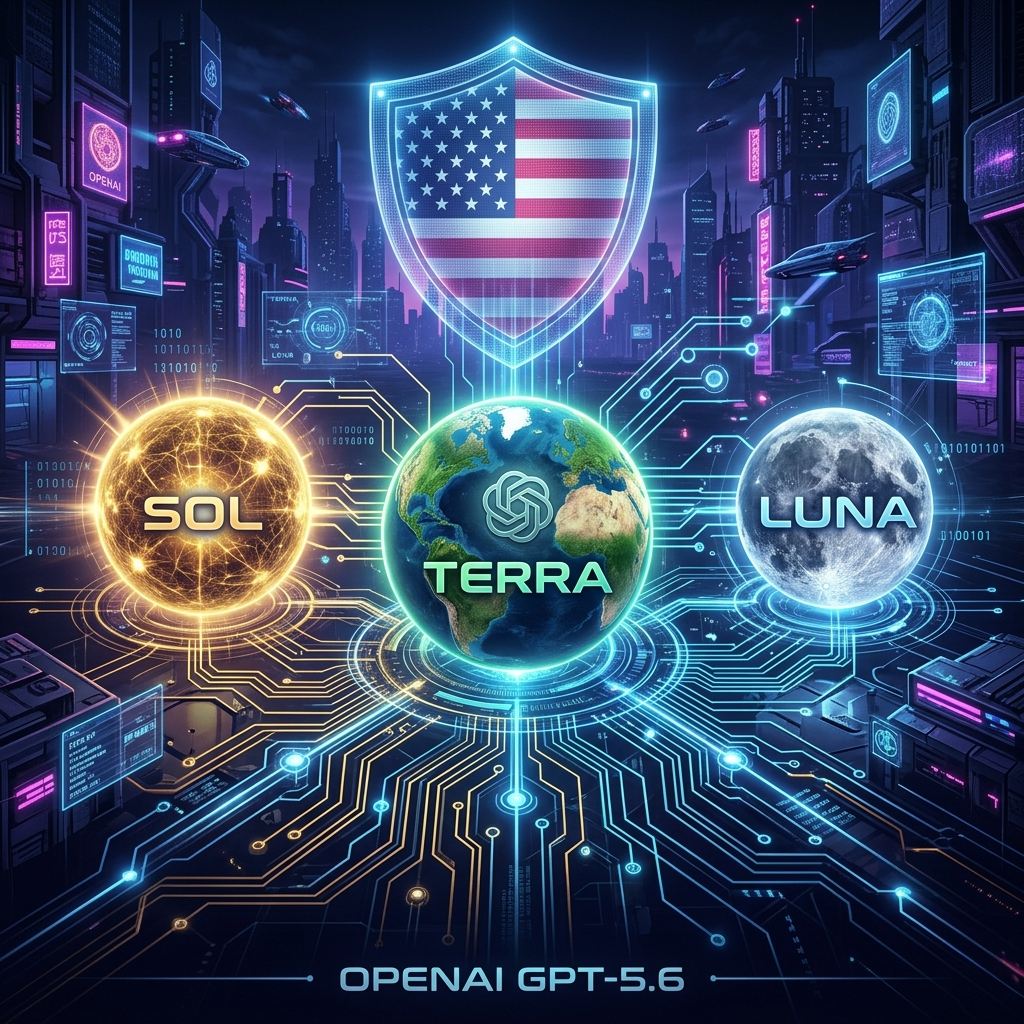
The GPT-5.6 family consists of three models tailored for different compute and latency needs: **Sol**, **Terra**, and **Luna**. Currently, access is restricted to a small select group of researchers and national security agencies. According to senior sources, this staggered roll-out is the direct result of federal reviews regarding AI safety, advanced cybersecurity capabilities, and compliance with the latest White House AI executive orders.
2. Meet Sol, Terra, and Luna
The GPT-5.6 series represents a major architectural advancement over previous iterations, dividing model capabilities to balance efficiency and raw cognitive performance:
- Sol (Flagship): The largest and most powerful model. Sol is engineered specifically for advanced scientific reasoning, complex codebase compilation, and defensive cybersecurity operations. Early benchmarks indicate it surpasses all existing models in multi-step planning and agentic execution.
- Terra (Mid-Tier): A balanced, cost-effective model designed for enterprise developers. Terra offers cognitive capabilities close to Sol but operates at a significantly lower cost structure, serving as the default transition model for businesses running complex API workflows.
- Luna (Lightweight): The fastest and most latency-sensitive model in the group. Luna is optimized for real-time customer service pipelines, rapid structured data extraction, and edge computing environments.
3. Why the U.S. Government Intervened
The decision to hold back the general public release of GPT-5.6 was not entirely voluntary. Under a recent executive order governing national security reviews for frontier AI models, developers are required to submit models exceeding specific compute thresholds to federal agencies for security assessments prior to wide distribution.
OpenAI's Sol model contains reasoning layers capable of writing code for software exploits and identifying zero-day vulnerabilities. While extremely useful for cyber defenders, these capabilities also present significant risks if deployed without proper safety filters. U.S. national security analysts requested a review period to evaluate Sol’s capabilities in threat simulation, prompting OpenAI to limit public API access to vetted US organizations during this testing phase.
4. Implications for AI Development and Safety
This coordinated release marks a major turning point in how frontier tech labs operate. Previously, companies like OpenAI and Google launched models with minimal external oversight. As systems transition from simple text generation to autonomous agentic reasoning, government-vetted releases will likely become the standard for any frontier AI system.
While some argue that this slows down public innovation, others believe it is a necessary step to prevent the misuse of advanced AI capabilities. For developers and businesses, this means that future access to flagship models might require formal verification and compliance processes, shifting AI development towards a more regulated, enterprise-grade architecture.
5. Frequently Asked Questions (FAQ)
Q: When will GPT-5.6 Sol be available in ChatGPT?
A: There is currently no official release date for Sol inside the consumer ChatGPT application. OpenAI expects to roll out Terra and Luna to API developers first, followed by consumer updates once the government-vetted security reviews are finalized.
Q: How does GPT-5.6 differ from previous versions?
A: GPT-5.6 introduces highly advanced reasoning capabilities that allow the model to plan, debug, and execute multi-step software tasks autonomously, moving beyond basic text generation into agentic operation.
📝 Editor's Opinion: Hussein Harby
"The GPT-5.6 Sol review marks the official end of the open AI frontier. From this point forward, frontier models will be treated as dual-use technologies, subject to national security oversight. OpenAI's willingness to comply shows that they prioritize regulatory alignment as they prepare for the launch of true agentic networks."