Table of Contents
? Key Takeaways
- 1. Introduction: The $1 Trillion Tech Vision
- 2. Decentralizing Chip Production: Samsung & SK Hynix
- 3. AI Data Center Mega Expansion
- 4. What is "Physical AI" and Humanoid Robotics?
- 5. Geopolitical and Industry Impact
1. Introduction: The $1 Trillion Tech Vision
South Korea has launched the most ambitious tech infrastructure plan in its modern history. In a joint government and private sector press conference, President Lee Jae-myung announced a monumental **$1 trillion (approx. 1.5 quadrillion won)** industrial strategy. The long-term plan targets three key high-tech pillars: advanced **semiconductor manufacturing**, massive **AI data centers**, and **"Physical AI"** (humanoid robotics and autonomous machinery).
This initiative represents a strategic shift designed to maintain South Korea's "super-gap" advantage in the global hardware supply chain. It also aims to distribute industrial growth outside of the Seoul metropolitan area, creating new technological hubs across the country's southwestern provinces.
2. Decentralizing Chip Production: Samsung & SK Hynix
The core of the strategy is centered on South Korea’s semiconductor crown jewels: **Samsung Electronics** and **SK Hynix**. The government plans to construct four new mega-fabrication plants (fabs) in southwestern candidate regions, such as Gwangju. This move shifts chip production away from the congested northern provinces.
Total investments in memory chip packaging, research hubs, and foundry expansion are expected to reach approximately **$500 billion** (800 trillion won) over the next decade. Samsung Electronics has supported this with a massive long-term domestic plan to invest up to $1.7 trillion through 2040 to expand high-bandwidth memory (HBM) and foundry capacities. For more details on memory developments, see our analysis of Samsung HBM4e AI memory chips.
3. AI Data Center Mega Expansion
To support the massive compute demand generated by frontier models like GPT-5.6 and Claude, South Korea is investing over **$650 billion** to build state-of-the-art AI data centers by 2035. These facilities will focus on running local neuromorphic processors and energy-efficient custom accelerators designed to reduce power usage.
By building local, high-density AI data centers, South Korea hopes to attract international AI companies looking for reliable compute infrastructure in East Asia. The integration of local memory chips directly into high-speed data center clusters is expected to lower latency for real-time AI agents.
4. What is "Physical AI" and Humanoid Robotics?
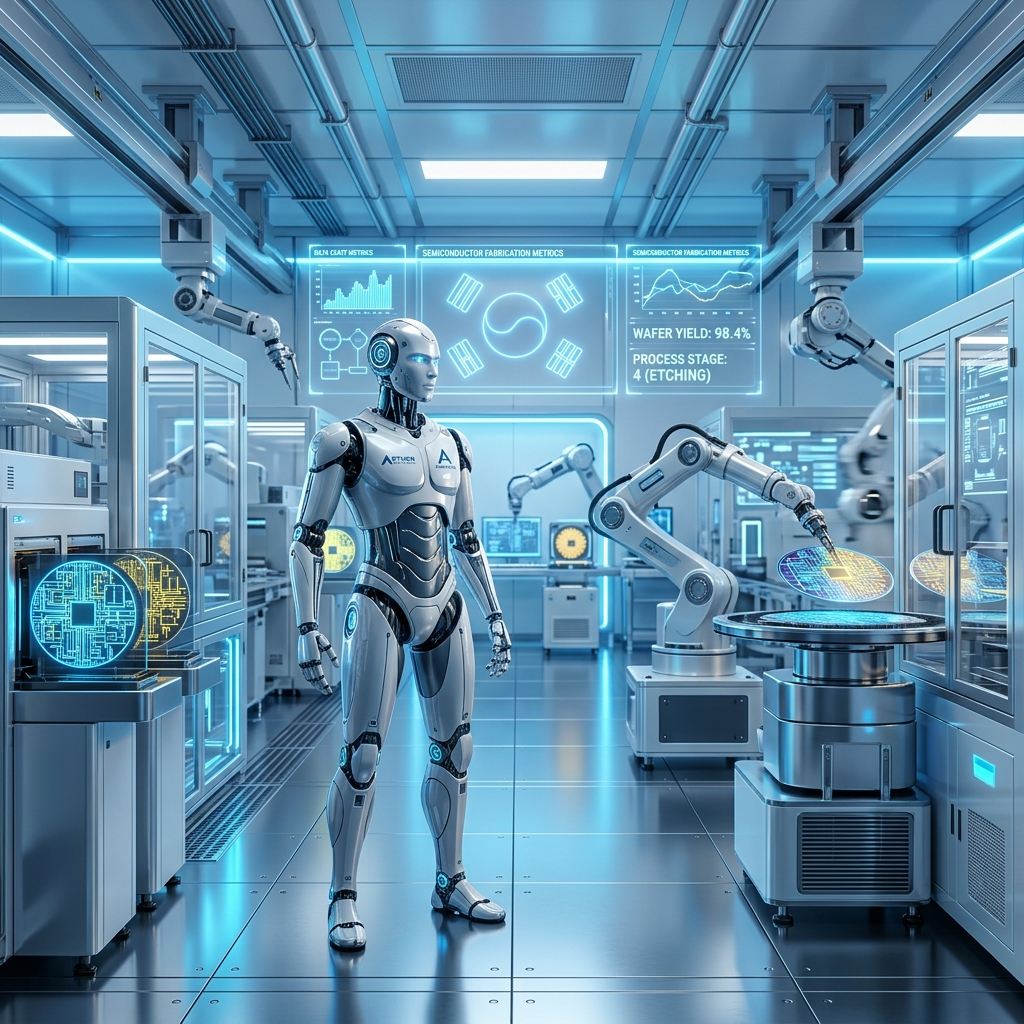
One of the most innovative aspects of the plan is the formal designation of **"Physical AI"** as a national strategic industry. In AI research, Physical AI refers to intelligent software systems embedded in real-world physical bodies—such as humanoid robots, autonomous factory drones, and self-driving transport trucks.
South Korea aims to become a top-three global power in AI robotics by 2030. Key milestones of the program include:
- Humanoid Industrial Share: Raising the ratio of humanoid robots used in local factories from 1% to 20% by 2030.
- Talent Pipeline: Training 10,000 highly specialized AI robotics engineers.
- Commercialization: Deploying industry-specific humanoid robots in shipping, agriculture, and assembly by 2028.
5. Geopolitical and Industry Impact
This plan has major implications for the global technology ecosystem. As tech competition between the U.S. and China increases, South Korea is positioning itself as a reliable, independent hardware foundation for global AI developers. If South Korea succeeds in combining memory, foundry, data centers, and robotics into a single domestic pipeline, it will secure a key role in the future of physical automation.
For developers, this means that we will see a major wave of hardware innovations in robotics and low-power AI inference chips, creating new options for edge computing and industrial AI deployments.
6. Frequently Asked Questions (FAQ)
Q: What is "Physical AI"?
A: Physical AI refers to artificial intelligence models integrated with physical hardware (such as robots, drones, and automated vehicles) that can perceive, navigate, and perform physical tasks in the real world.
Q: Who is funding the $1 trillion investment?
A: The strategy is a public-private partnership. Conglomerates like Samsung Electronics, SK Hynix, LG Electronics, and Hyundai are funding the majority of the hardware fabs and robotics research, supported by government infrastructure spending and tax incentives.
?? Editor's Opinion: Hussein Harby
"South Korea's $1 trillion strategy is a direct play for the next era of AI. The software boom of the last few years is shifting toward the physical world. By focusing on Physical AI and memory chip hardware, South Korea is positioning itself to own the physical infrastructure of the AI century, from the factories that assemble chips to the humanoid robots that package them."
Related Articles